
Three Groups
The conflict illustrated

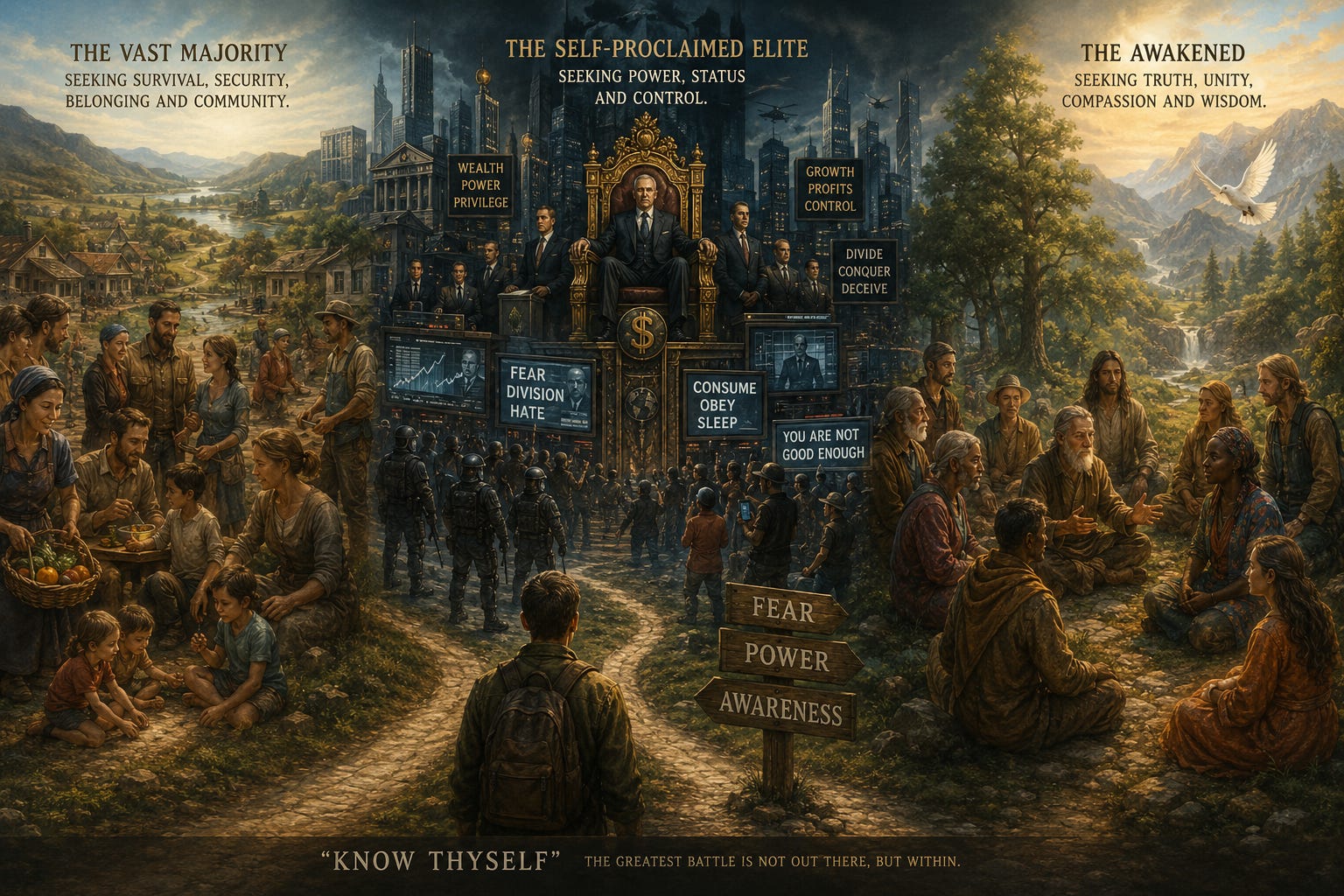
Although it is risky to divide humanity into broad categories, certain recurring patterns of behaviour appear throughout history and across cultures. These patterns are not rigid classes into which people are permanently assigned. Rather, they are tendencies or orientations that emerge under different circumstances. Most individuals contain elements of all three, but usually one becomes dominant.
The Vast Majority
The first and largest group consists of those whose primary concern is survival and stability. Their attention is directed toward meeting the practical demands of life: securing food, water, shelter, rest, health, and safety for themselves and those they love.
Even when basic physiological needs are met, security concerns remain. People seek protection from harm, financial stability, meaningful work, reliable institutions, and a predictable environment in which to raise children and plan for the future. Families, friendships, neighbourhoods, and communities become the structures through which these needs are fulfilled.
Belonging is central to this group. People naturally gather into families, tribes, religious communities, nations, and cultures. These associations provide identity and mutual support, but they can also create boundaries between those who belong and those who do not. The same instincts that foster solidarity can, when threatened, produce suspicion of outsiders.
Within these communities, the work of sustaining relationships often falls disproportionately upon women, who preserve the bonds of family life, friendship, care, and emotional continuity. Men who are dependable and devoted to these responsibilities deserve respect, but societies often overvalue masculine displays of authority while overlooking the quieter labour required to create a home and maintain human connection.
Despite its imperfections, this majority tends to be oriented toward some conception of the common good. Most people desire neither domination nor exceptional power. They wish for security, dignity, companionship, and the opportunity to see their children flourish. Their ambitions are generally grounded in participation within a community rather than superiority over it.
The Self-Proclaimed Elite
The second group consists of those who seek power, status, and influence over others. Some inherit privilege through wealth, family, or position. Others rise from ordinary circumstances but become captivated by prestige, recognition, or the desire to command.
This group is not defined simply by wealth. Many wealthy people remain deeply connected to the concerns of ordinary life. Nor is it limited to political rulers, corporate executives, or aristocrats. It includes anyone whose primary motivation becomes the acquisition, preservation, or expansion of power.
Around every elite gathers a secondary class of aspirants and loyalists. These individuals seek proximity to power, often believing that status and significance can be obtained through service to those above them. Some eventually succeed, while many spend their lives chasing acceptance that never fully arrives. Nevertheless, their usefulness ensures that they are continually encouraged to believe that they are participants in a grand project.
The language employed by this group frequently invokes progress, growth, security, or necessity. These goals are not inherently illegitimate, yet they often conceal narrower interests. Economic growth may become synonymous with the accumulation of private assets. National security may become a justification for expanding authority. Meritocracy may be celebrated while structural advantages remain unacknowledged.
The self-proclaimed elite thrives on hierarchy. It depends upon the belief that some people are inherently entitled to rule while others exist primarily to serve. Consequently, it often promotes competition, envy, and status-seeking among the wider population. The promise is that anyone may rise; the reality is that only a small minority can occupy the highest positions.
Power itself becomes addictive. Those who possess it fear losing it. Those who desire it fear being excluded from it. In this environment, corruption flourishes, not merely in the legal sense but in the moral sense: people gradually begin valuing influence more than truth, victory more than justice, and status more than human dignity.
The Awakened
The third group consists of those who recognise the limitations of both survival-driven existence and power-driven ambition. They may emerge from the Vast Majority or from the ranks of the elite. What distinguishes them is not intelligence, education, wealth, or social standing, but a shift in perspective.
These individuals perceive that many of the divisions separating human beings are artificial or exaggerated. They recognise how fear can be manipulated, how status can become a substitute for meaning, and how power often disguises itself as virtue.
Many are well-read and culturally informed, though not necessarily academics. Others arrive at similar insights through lived experience, hardship, contemplation, spiritual practice, or service to others. Their common characteristic is a commitment to understanding rather than domination.
The Awakened tend to value truth above ideology, compassion above tribal loyalty, and wisdom above status. They seek what unites human beings rather than what separates them. While they appreciate cultural differences, they search beneath them for universal principles: kindness, justice, beauty, courage, and the recognition of shared humanity.
Throughout history, such people have appeared as philosophers, prophets, saints, reformers, artists, scientists, teachers, and ordinary citizens who refused to surrender their conscience. They are often viewed with suspicion by both the masses and the powerful. The masses may find their ideas unsettling, while elites frequently perceive them as a threat because they expose illusions upon which systems of domination depend.
The Awakened are not perfect. They are as human as everyone else. Their distinguishing feature is not moral superiority but an ongoing effort to transcend fear, resentment, and the pursuit of power. They understand that genuine fulfilment is found neither in mere survival nor in domination, but in participation in something larger than oneself.
A Final Observation
These three groups should not be understood as fixed categories. The same individual may inhabit all three at different moments of life. In times of hardship, survival becomes paramount. In moments of ambition, the temptation of power arises. In moments of clarity, compassion and wisdom emerge.
The struggle between these orientations is therefore not merely social or political; it is internal. Every human being contains the desire to survive, the desire to dominate, and the desire to awaken. The history of civilisation can be read as the unfolding tension between these three impulses, both within societies and within the human heart itself.
One last point remains. Throughout history, power has repeatedly corrupted individuals, institutions, and entire civilisations. The record of conquest, exploitation, and domination has been so pervasive that many have come to regard aggression, competition, and militancy as the natural condition of humanity itself.
The wisdom traditions of the world have generally challenged this assumption. Whether expressed through philosophy, religion, or contemplative practice, they suggest that humanity’s destructive tendencies arise not from its deepest nature but from ignorance—ignorance of oneself, of others, and of the interconnectedness of life. Fear, greed, envy, and the desire for domination flourish where understanding is absent.
For this reason, the great traditions repeatedly return to a similar injunction. The inscription at Delphi urged, “Know thyself.” Eastern traditions speak of awakening, enlightenment, or self-realisation. Mystical traditions describe the removal of veils that obscure reality. Though their languages differ, they point towards the same possibility: that human beings can awaken from the illusions that bind them.
The conflict between power and wisdom is therefore not merely political or social. It is an inner struggle present within every individual. The impulse to dominate, the impulse to belong, and the impulse to awaken coexist within us all. Civilisations are shaped by which of these impulses they choose to cultivate, but the choice begins within the human heart.