
Hail … Trump?
An imaginative speculation

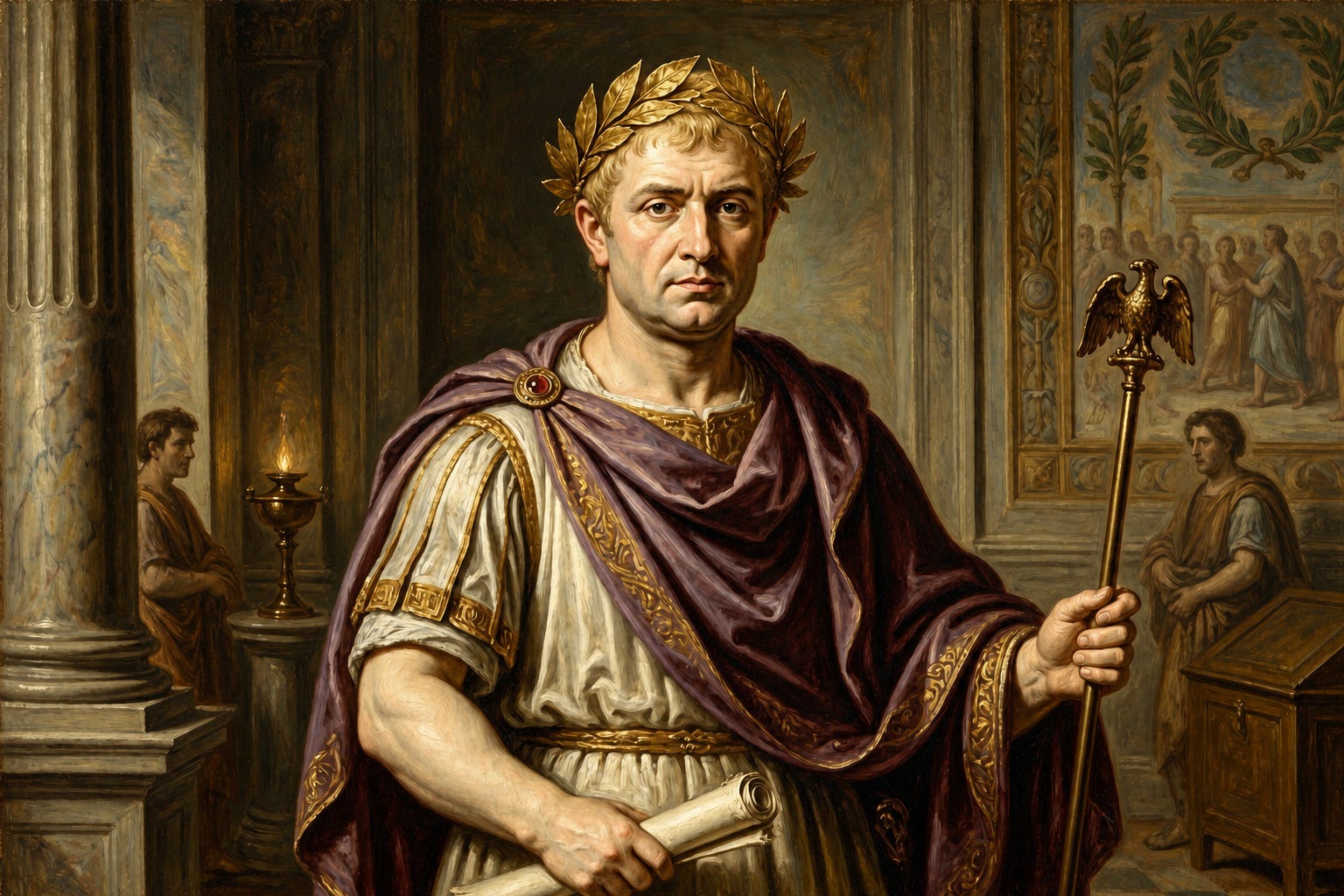
What I didn’t expect was for Nero to re-emerge in the form of an American president who adopts the same style of rule, public image, and attacks on institutions. Trump and Nero are most similar in that they both rely on spectacle and highly polarising rhetoric rather than calm, institutional leadership and demand personal loyalty. Nero was renowned for his theatrical self-presentation, and Trump has built his political identity around rallies, media attention and constant publicity in a similar way. Both figures have been described as amassing power for themselves, with loyalty to the leader often being valued more highly than loyalty to institutions.
They both have/had a disdain for critics and the media. Sources compare Nero’s hostility towards opponents and writers with Trump’s repeated attacks on the press and political enemies. They both appeal directly to their supporters with simple slogans and emotional messaging, thereby irritating or bypassing elites. Nero’s performances and public displays are often compared with Trump’s media theatrics and larger-than-life branding. They are also both described as using enemies, crises or outsiders to unite their supporters against a common target. Commentary on both figures also stresses the importance of appointments and alliances based on loyalty rather than competence.
However, we might argue that the comparison is historically imperfect. After all, Nero ruled an imperial dictatorship, whereas Trump operated within a modern constitutional system involving elections, courts and, to a certain extent, checks and balances; therefore, the two are not politically equivalent. When Nero committed suicide in June 68 CE, his political legacy was negative and destabilising. He also left behind a reputation for tyranny, extravagance and persecution that shaped Roman memory and later Christian tradition.
Nero finally killed himself when he lost all political and military support. The Senate had declared him an enemy of the state, stripping him of legitimacy and effectively outlawing him, which meant that any loyal subject who helped him would be considered a criminal. At the same time, the army and the Praetorian Guard, his core instruments of power, deserted him for rival claimants, particularly Galba. This meant that he no longer had armed protection or a reliable body of supporters to rally.
With his authority gone, his capital surrounded by opposition and his enemies closing in step by step, he faced not just death, but a highly ritualised and dishonourable execution. He would likely have been captured, paraded and killed in a manner designed to erase his dignity and memory as a ruler. In this context, suicide was his last act of agency and a way to choose the moment, manner and narrative of his end rather than letting his enemies control it. By taking his own life, he avoided the spectacle of a trial and execution, escaped the humiliation of public degradation and attempted to preserve at least a shred of imperial self-possession in the face of total political collapse.
His suicide removed the last direct heir of Augustus’s family, creating a vacuum that produced competing claimants and open conflict across the empire. Military commanders and provincial governors vied for power, and Rome entered a period of rapid succession and civil war that exposed the fragility of imperial succession in the absence of clear rules. It also highlighted the real power of the army and provincial elites over the imperial throne. Legions and governors could make or break emperors, and the reliability of the Praetorian Guard proved uncertain. This undermined the façade of smoothly hereditary Julio-Claudian succession, encouraging later emperors and rivals to secure military backing as the decisive instrument of rule.
How will we remember Trump?
Contemporary senatorial historians portrayed Nero as a consummate tyrant. He was vain, cruel and decadent, and this depiction dominated elite memory for centuries. Popular memories were more mixed, and he had supporters among ordinary Romans and sponsored public entertainments and building works, but the lasting image that has endured is that of excess and misrule. This has made his name synonymous with bad emperorship in Roman literature.
Trump has cultivated a public persona with many Nero‑like traits: a politics centred on spectacle, personal loyalty, and feud‑driven polarisation, alongside a tendency to delegitimise opponents and institutions. In this light, the comparison to Nero is not about direct historical equivalence but about structural risk—what happens when a leader’s identity becomes so tightly fused with the political system that his departure or collapse leaves a legitimacy vacuum. When Nero fell, the immediate result was the Year of the Four Emperors, a period of civil war and rapid regime change in which rival military commanders and provincial governors jockeyed for the purple, revealing how fragile Roman imperial succession was once the dynastic façade cracked.
The question, then, is whether an analogous period of institutional chaos could follow Trump’s exit from office or death. In strictly formal terms, the United States is far more insulated than the Principate: it has term limits, written constitutions, regular elections, and a clearer line of succession than the Roman Empire did after Nero. Moreover, the U.S. state is more bureaucratized and less dependent on a single commander’s personal charisma to hold the army together.
Yet the real danger lies less in the structure of the system and more in its social and cultural authority: if large segments of the population come to see the constitutional order as illegitimate or “stolen,” and if key institutional actors (military units, paramilitary networks, or state‑level officials) begin to align with partisan loyalty over legal procedure, the groundwork is laid for semi‑constitutional or de facto crises.
We may say that a full “Year of the Four Emperors” scenario is impossible in the United States, but that confidence rests on norms and habits, not on iron‐clad guarantees. The upheavals of the last several years, with political violence, mass attempts to overturn an election, and deep distrust in the basic machinery of democratic transfer, already show that what once seemed unthinkable is not only possible but has already begun to unfold in milder forms.
The bigger risk is not that the U.S. will literally replicate the Roman succession crisis, but that it could enter a period of repeated, contested transitions, where each change of power is treated as a near‑existential rupture, policing and the military are pressured to “take sides,” and legitimacy hinges more on personal loyalty to a leader than on the rule of law. In that sense, the usefulness of the Nero analogy lies not in predicting a carbon‑copy civil war, but in warning that when a leader’s persona outgrows the institutions that contain him, the system may fracture in ways that nobody, beforehand, would have believed possible.
Persecution and Oligarchy
In the Christian tradition, Nero’s reign is remembered as marking the beginning of significant imperial persecution of Christians, although the scope of this persecution may have been exaggerated in later accounts. Some early Christian writings used his name as a code for anti-imperial critique. Culturally, his patronage of the arts and dramatic self-presentation fuelled long-standing debates about the relationship between imperial power and cultural performance.
Following the Great Fire of Rome, he initiated major rebuilding work, creating ambitious projects such as the Domus Aurea, which left a tangible mark on the city. However, these projects also provoked resentment, as they symbolised the appropriation of public space for private use and the heavy expenditure of the imperial government. Therefore, his building programme contributed to an architectural legacy as well as elite hostility.
In summary, Nero’s death marked the end of a dynasty and triggered instability. His governance left behind a mixed legacy of administrative reforms and public works, yet he is primarily remembered for his destructive impact on elite norms, his harm to imperial stability and his role in fostering hostile literary and religious portrayals.
Trump’s legacy is likely to be an oligarchy with feudal tendencies: a system in which political power is no longer held by the people, or even a broad elite, but by a small, tightly interlinked network of ultra-wealthy individuals whose interests are protected by weak institutions, compliant courts and a polarised public. In this world, elections and constitutions remain in place as mere formalities, while real decision-making regarding the economy, security and even basic social norms is conducted through backroom deals, lobbying networks and personal loyalties, rather than open debate or democratic accountability.
A ‘feudal’ aspect stems from the organisation of power around personal fiefdoms such as corporate empires, media conglomerates, and private security-tech complexes that command private armies in the form of surveillance systems, data empires, and paramilitary-style security. Meanwhile, ordinary citizens have little recourse beyond petitioning or hoping for favour.
Within this emerging structure, the ‘Tech Barons’ are more than just CEOs; they are the de facto rulers of the core infrastructures of daily life: the platforms that determine what people see, the algorithms that govern labour and credit, and the systems that track, profile and influence behaviour. While these barons may nominally obey the law, they bend it, exploit loopholes and often set the de facto rules of the digital and economic environment long before legislatures catch up. For large portions of the population, life becomes a kind of feudal dependency: workers, gig labourers and the underinsured are tied to platforms and data-driven systems that dictate their income, mobility and even social standing, while their real bargaining power shrinks. They control not just websites and apps, but also the architecture of opportunity itself: credit scores, job-matching algorithms, content-moderation regimes and surveillance-driven policing.
Trump’s own symbiosis with this emerging order and his embrace of deregulation, tax-favoured capital and performative hostility towards the ‘deep state’ while leaving corporate power almost untouched, accelerates the drift towards such a system. His legacy is not just a changed presidency, but also a destabilised regulatory and legal environment in which the wealthy and well-connected can consolidate their control.
Meanwhile, the rhetoric of ‘freedom’ and ‘merit’ masks the reality of a new, agrarian-like hierarchy comprising a small class of digital manorial lords and a vast underclass of data serfs who are precariously dependent on the platforms that connect them to work, community and the public sphere. In this way, the idea of ‘tech barons who control everything’ is not just a dystopian fantasy, but a realistic extrapolation of where current trends of unchecked private power, weakened state capacity and mass social fragmentation could lead under the political culture that he helped to normalise.
Too late?
This question haunts any reflection on Trump’s political trajectory and its long-term consequences. If by ‘too late to prevent any of this’ we mean that it is too late to stop the patterns of his presidency from normalising — personalised rule, the erosion of institutional trust, the fusion of media spectacle and political power, and the deepening of a two-tiered society — then the answer is partly yes: these patterns have already reshaped the landscape of American politics and economics. The rise of an oligarchic, almost feudal order in which vast swathes of life are governed by concentrated financial, political and digital powers is already well underway.
However, if we ask, ‘Is it too late to change course?’, the answer is less clear. Weakened institutions are not necessarily destroyed, and norms can be rebuilt if enough people care about them and new forms of resistance, solidarity and constraint emerge. The analogy with Nero and the Year of the Four Emperors is a warning, not a prophecy: systems that allow one leader’s identity to override the rules of succession and legitimacy do not collapse overnight; however, they can decay into a series of nested crises that can only be repaired by plural, rule-bound and genuinely accountable structures. Therefore, the question is not just whether it is too late, but also whether there is still time to choose a different kind of loyalty: to shared institutions, to the common world and to one another rather than to the technological or political barons who claim to control everything.
Sometimes, other people get what they want.