
Escape into Madness
The disorienting and fantastical qualities of contemporary discourse

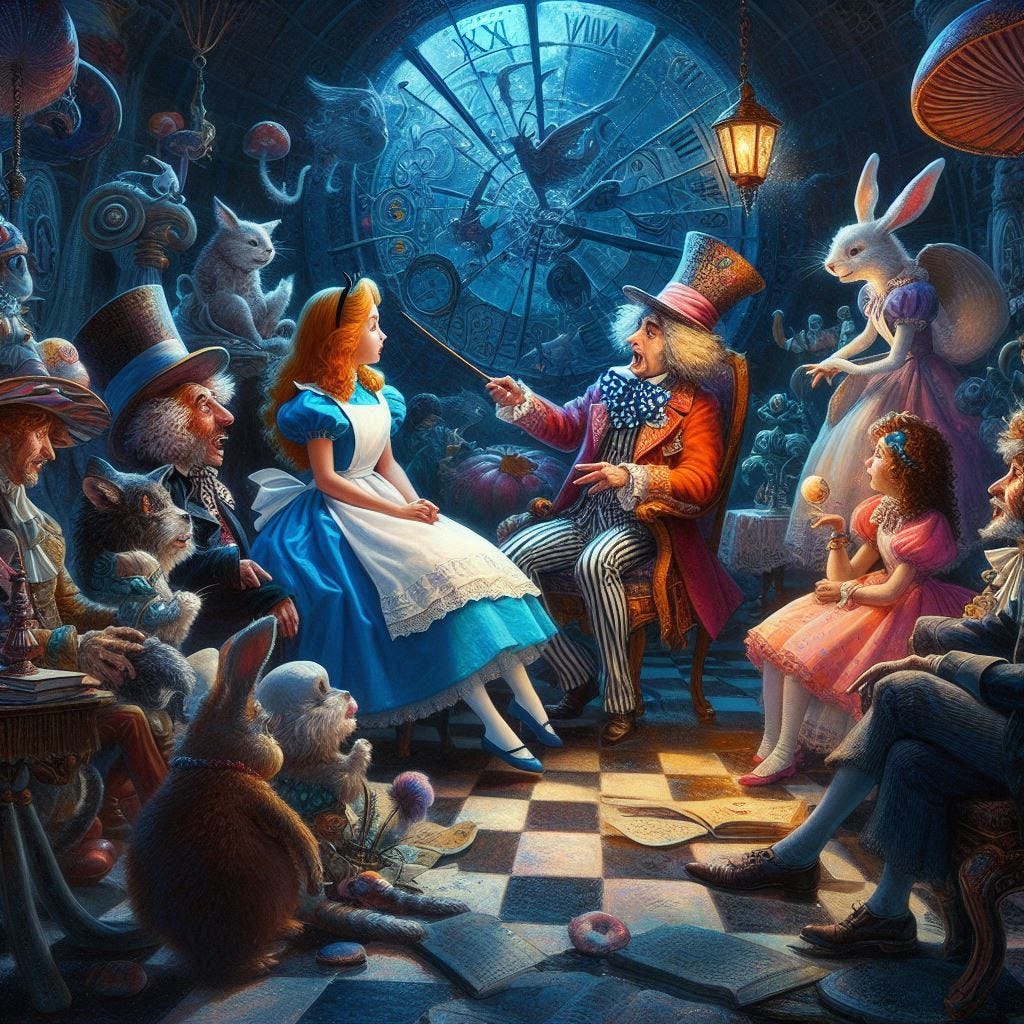
Many contributions to discussion forums and social media demonstrate that Iain McGilchrist's suggestion that we are experiencing a loss of wisdom, creativity and the ability to deal with complexity and ambiguity is correct. Instead of engaging thoughtfully with complexity, many discussions devolve into superficial amusement, tribalism, or fantasy.
People would rather derail any discussion in favour of amusement; they would rather let their minds wander among fantasies and assume that anything they can imagine must be true. Reason and a global, holistic and unifying understanding that balances rationality with wisdom, perspective and a sense of proportion are completely foreign to them. Their take on the world at large is akin to a computer game more than physical and transcendental reality.
Why Does This Happen?
Several factors contribute to this problem:
Digital Environments: Social media and forums reward quick, attention-grabbing responses rather than thoughtful reflection.
Cultural Shifts: Emphasis on measurable outcomes and efficiency over depth and meaning.
Educational Gaps: Less focus on philosophy, critical thinking, and the arts, which nurture holistic thinking.
It can be seen as a manifestation of the following:
Reductionism
Reductionism is the tendency to simplify complex phenomena by breaking them down into their smallest components and treating those components as a whole. While analysis can be useful, excessive reductionism can lead to the overlooking of the richness, nuances and interconnectedness of real-world situations.
This can manifest in various ways, including in science, where human consciousness is explained solely in terms of neurons firing, without considering subjective experience or social context. In the context of social issues, it manifests as attributing poverty solely to individual laziness while ignoring systemic, historical and economic factors. In my view, reductionism is most clearly evident in online discourse, where nuanced debates are reduced to binary choices (“good” vs “bad,” “us” vs “them”).
The consequences are clear: a loss of depth and complexity in understanding; solutions that fail because they address symptoms rather than root causes; and a culture that undervalues holistic or integrative thinking..
Literalism
Of course, literalism is the habit of interpreting words, statements or texts only at their most basic surface level without recognising metaphor, irony, humour or deeper significance.
We encounter this tendency in communication when people misunderstand satire or sarcasm, for example, but it also occurs in religion or literature when sacred texts or classic works are read only as historical fact rather than as allegory or moral teaching. People often respond to jokes or figurative language as if they were factual claims.
This stifles creativity and subtlety in conversation, leading to unnecessary conflict or confusion and preventing the full appreciation of art, literature and culture.
Fragmentation
Fragmentation involves focusing on isolated facts, events or issues without considering how they fit into larger patterns, systems or contexts. This can be seen in news media reporting on individual crimes without exploring broader social trends or causes, and in education when subjects are taught in isolation, preventing students from seeing interdisciplinary connections. However, it is particularly evident in online forums and social media, where debates become mired in minor details and lose sight of the main issue.
The consequence for society is an inability to see the 'big picture', poor decision-making due to a lack of context and difficulty solving complex problems that require an integrated approach.
Escapism
Escapism, the preference for distraction, entertainment or fantasy over engaging with life's challenges and realities, is a major feature of modern life. Media consumption, particularly binge-watching shows or endlessly scrolling through social media, is a way of procrastinating in order to avoid uncomfortable feelings or responsibilities.
In online communities, focusing on memes, games, or celebrity gossip can result in meaningful discussion being not only postponed but also abandoned. Instead, large numbers of people retreat into conspiracy theories or utopian fantasies, rather than grappling with real-world complexities.
It is no wonder, then, that we feel that personal and societal growth is being avoided, that civic engagement and responsibility are weakening, and that we are becoming increasingly vulnerable to manipulation and misinformation.
Why Does It Matter
All four tendencies — reductionism, literalism, fragmentation and escapism — undermine our ability to think deeply, relate meaningfully and act wisely. Together, they contribute to a culture that struggles with complexity, nuance, and ambiguity, echoing the concerns raised by thinkers such as Iain McGilchrist.
Becoming aware of these pitfalls is the first step towards more thoughtful, creative and connected ways of living and communicating.
The Erosion of Wisdom and Creativity
McGilchrist would probably say that these tendencies show that we are becoming less wise as a society. True wisdom requires:
Contextual Understanding
Contextual understanding involves grasping the broader circumstances, history, relationships and systems surrounding an issue or event. It means seeing the 'big picture' and recognising that no fact or action exists in isolation.
In the context of social issues, for instance, it means appreciating that crime rates are affected by economic, educational and community factors, rather than just individual choices. In communication, it may manifest as interpreting someone’s words or actions in light of their background, culture, or current situation. In science or medicine, we must consider not just a patient’s symptoms, but also their environment, lifestyle and mental health.
This approach has many benefits. It leads to more accurate, fair and compassionate judgements; helps to prevent misunderstandings and oversimplifications; and enables more effective solutions by addressing root causes rather than just symptoms.
Tolerance for Ambiguity
Tolerance for ambiguity is the ability to remain comfortable and open-minded in situations where information is incomplete, contradictory, or unclear. It’s the recognition that not all problems have simple, black-and-white answers.
For example, in decision-making, it means withholding judgment until enough evidence is available or accepting that some uncertainty will always remain. In relationships, it means allowing for complexity in people’s motives and behaviours, rather than demanding certainty or consistency. And in Learning, embracing the process of exploration and uncertainty as part of intellectual growth is beneficial.
It reduces anxiety and defensiveness when facing complexity, encourages curiosity, patience, and deeper inquiry, and fosters open-mindedness and adaptability in a rapidly changing world.
Imagination and Creativity
Imagination and creativity are the ability to envisage new possibilities, generate original ideas and synthesise information in novel ways. They are the sparks that drive innovation, art, and progress.
In problem solving, it means devising unconventional solutions or spotting connections that others overlook. In art and science, it means creating new works, theories or inventions that challenge the status quo. In everyday life, reimagining routines, roles or relationships to better suit one's needs and values can enrich our experience.
Imagination and creativity drive innovation and progress in all fields. They help individuals and societies adapt to change and enrich life with meaning, beauty and possibility.
Balance
Balance involves integrating different ways of knowing and being, combining rational analysis with intuition, empathy and proportion. It involves harmonising logic and emotion, detail and overview, and the self with others. Balance is especially valued in the Far East, where it is considered a foundational principle across many philosophical and cultural traditions.
Leaders in their professions often recognise that the necessity of making decisions informed by data needs to be balanced by considering human impacts and ethical values. In personal life, too, it is important to weigh practical needs against emotional well-being and relationships. Similarly, when we use both critical thinking and imaginative insight to understand complex issues in our thoughts, we find that it leads to wiser, more sustainable choices and prevents extremes and one-sided thinking, supporting holistic well-being for individuals and communities.
Why These Qualities Matter
Together, the qualities of contextual understanding, tolerance for ambiguity, imagination, creativity and balance form the foundation of wisdom. They enable us to navigate complexity, respond to uncertainty and foster a society that is more thoughtful, compassionate and innovative. Cultivating these capacities is vital for personal development, effective leadership and the well-being of our communities and culture.
The 'Alice in Wonderland' Analogy
Lewis Carroll’s Alice in Wonderland is famous for its dreamlike logic, shifting identities, and playful subversion of meaning and reason. In the story, Alice finds herself in a world where the rules of ordinary reality no longer apply—logic is twisted, language is slippery, and the line between sense and nonsense is blurred.
When I liken modern cultural and online developments to this kind of hallucination, I’m highlighting several key features of social media and discussion forums:
Loss of Coherence: Conversations and debates often lack continuity or logical progression, much like the nonsensical dialogues in Wonderland.
Distorted Reality: Opinions, fantasies, and misinformation are often treated as equally valid, blurring the distinction between fact and fiction.
Escapism: There is a tendency to retreat into entertaining distractions or ideological bubbles, rather than confront challenging realities.
Absurdity: The proliferation of memes, irony, and performative outrage sometimes makes public discourse feel surreal or detached from any shared sense of meaning.
McGilchrist, Madness, and Meaning
Iain McGilchrist’s work resonates with this metaphor. He warns that an overreliance on the left hemisphere’s abstract, decontextualised reasoning can lead to a kind of collective “madness”—a world where we lose touch with lived experience, embodied meaning, and the grounding context that the right hemisphere provides.
Hyper-rationality Can Become Irrational When It Loses Sight of the Whole
Rationality is often celebrated as the pinnacle of human thought. However, when this way of thinking becomes hyper-focused on logic, analysis and detail to the exclusion of context, emotion and interconnectedness, it can paradoxically lead to irrational outcomes.
This is evident in many areas, including the medical field. When I started working in geriatric care, it was common practice to treat patients as a collection of symptoms rather than as whole people, which sometimes resulted in ineffective or even harmful care.
But I also see signs of this in policymaking. We are increasingly seeing policies based solely on statistics without considering human experience or cultural context, resulting in solutions that fail in practice. This spreads into our personal lives, where people begin to overanalyse every decision, which can lead to paralysis and anxiety rather than wise action.
This kind of 'madness' is not an absence of rationality, but a loss of the wisdom that comes from seeing the bigger picture — or what we might call “the whole.”
Imagination Untethered from Reality Can Devolve into Fantasy or Delusion
Imagination is a powerful tool for creativity and progress. However, when it becomes disconnected from reality, with no grounding in facts, shared experience or practical possibility, it can spiral into fantasy, wishful thinking or even delusion.
Conspiracy theories are a good example of this. These are elaborate narratives with little or no basis in reality, yet they are passionately believed and acted upon. Escapism is another example, whereby individuals or groups retreat into virtual worlds, ideologies or utopian schemes, ignoring urgent real-world issues.
Misinformation goes 'viral' on social media because it is imaginative or sensational, not because it is true. However, this form of 'madness' is not a sign of creative genius, but rather a dangerous detachment from the realities that anchor us as individuals and as a society.
Language Loses Its Power to Connect Us When It Becomes Mere Wordplay or Manipulation
Language is a bridge between minds, enabling shared meaning, understanding and cooperation. However, when language is reduced to clever wordplay, empty rhetoric or deliberate manipulation, it ceases to connect us, instead confusing, dividing or deceiving us.
In politics, for example, words are increasingly used to obscure the truth, evade responsibility or inflame emotions, rather than inform or unite people. Online conversations devolve into trolling, sarcasm or semantic games with little regard for genuine understanding. In academia, communication becomes so specialised or abstract that it excludes all but the narrowest of audiences, losing its broader relevance.
The “madness” I am referring to is the breakdown of communication and meaning, which leaves us isolated in our own interpretations or echo chambers.
The Deeper Alienation
In all these cases, the 'madness' described is not just an absence of logic or reason, but a profound disconnection from the personal, social and existential realities that provide life with coherence and meaning. It is a loss of connection to the whole, to reality, and each other.
According to this view, true sanity is not just rationality, but the ability to integrate reason, imagination and communication in a way that remains anchored in reality while remaining open to the richness and complexity of life.
In the 1980s, I read Erich Fromm, who argued that modern individuals become dominated by the products of their own creation — technology, institutions, and consumer goods — to the extent that they relate more to things and images than to authentic reality or each other. He gave the example of mistaking television images for reality, reflecting the idea of people inhabiting a fantasy or hallucination rather than engaging with the real world.
Drawing on the biblical concept of idolatry, he described how people come to worship their own creations, mistaking these for reality. This is analogous to my metaphor of living in a dreamlike or hallucinatory state where fantasy replaces genuine experience and meaning.
What Can Be Done?
While these trends are concerning, there are ways to foster the qualities McGilchrist champions:
Promote Dialogue: Encourage open-ended, respectful discussion rather than debate or point-scoring.
Value the Arts and Humanities: Support education that develops imagination, empathy, and critical thinking.
Model Wisdom: Share examples of nuanced, integrative thinking in public discourse.
Slow Down: Create spaces—online and offline—for reflection rather than instant reaction.
I agree with McGilchrist's warning about the dangers of a culture dominated by the left hemisphere's perspective on the world. In order to recover wisdom, creativity, and the ability to handle complexity, we must make a conscious effort to balance rationality with holistic, contextual, and imaginative ways of thinking, both individually and collectively.
When I liken our cultural trajectory to an 'escape into madness', like an Alice in Wonderland hallucination, it is a metaphor that perhaps captures the disorienting and fantastical qualities of contemporary discourse, as well as the sense of losing touch with grounded reality.
Is There a Way Back?
The Alice in Wonderland metaphor is powerful because, in the story, Alice ultimately wakes up—she returns to reality, changed by her experiences but no longer lost in the dream.
Similarly, McGilchrist and others suggest that recovery is possible.
Reintegrate the Whole
To “reintegrate the whole” means to restore balance and connection between the different faculties of the mind and ways of knowing. It involves moving beyond one-sidedness—such as a narrow focus on analysis or unchecked fantasy—toward a harmonious interplay between:
Analysis and Synthesis: Not just breaking things down into parts (analysis) but also seeing how the parts fit together into a meaningful whole (synthesis).
Reason and Intuition: Valuing logical thinking while also trusting gut feelings, instincts, and insights that come from experience or subconscious processing.
Fantasy and Reality: Encouraging imagination and creativity, but keeping them anchored to the real world, so that new ideas are both innovative and relevant.
Ground Ourselves
To “ground ourselves” is to root our thinking and actions in lived experience, context, and shared meaning. It’s about staying connected to the realities of our bodies, communities, cultures, and the natural world.
Value Context: Always ask, “What is the bigger story here?” Recognise that every issue has a history, a setting, and relationships that shape its meaning.
Embodied Experience: Trust the wisdom of the body—sensations, emotions, and intuition—as sources of knowledge, not just abstract thought.
Shared Meaning: Engage in practices and conversations that build mutual understanding and a sense of belonging.
I have discovered how valuable it is to spend time in nature, practise mindfulness or engage in physical activities that connect you to your body and the environment around you. It is important to listen deeply to others’ stories and perspectives, especially those that differ from your own. Participating in rituals, arts or traditions that foster community and continuity is also beneficial as a way to ground ourselves.
Cultivate Wisdom
Cultivating wisdom involves nurturing the qualities that enable us to navigate complexity and uncertainty with discernment, compassion and creativity. It's not just about acquiring knowledge, but also about developing the ability to apply it effectively.
Critical Thinking: Teach and practice the ability to question assumptions, evaluate evidence, and think independently.
Empathy: Develop the ability to see the world through others’ eyes, to feel with them, and to care about their well-being.
Imagination: Encourage the ability to envision alternatives, dream new possibilities, and synthesise diverse ideas—but always test these against reality.
We need to support educational systems that prioritise teaching people how to think rather than what to think. This can be found in philosophy, the arts, and reflective practices, rather than just technical skills. We should also encourage lifelong learning, curiosity and open-mindedness, as well as humility and a willingness to admit uncertainty or error.
Therefore
Recovery becomes possible when we move beyond narrow, fragmented or disconnected ways of thinking and living. By reintegrating the whole, grounding ourselves in context and experience, and actively cultivating wisdom, we can restore balance, meaning and sanity, both individually and collectively. McGilchrist and others offer this as a hopeful alternative to the cultural 'madness' of our time.
Describing our cultural moment as an 'escape into madness' or an 'Alice in Wonderland hallucination' is my way to express the confusion, absurdity and disconnection that many people feel. The challenge — and the hope — is to find our way back to a more grounded, integrated and meaningful engagement with reality.