
Break Free!
Embodying the Reality We Long For

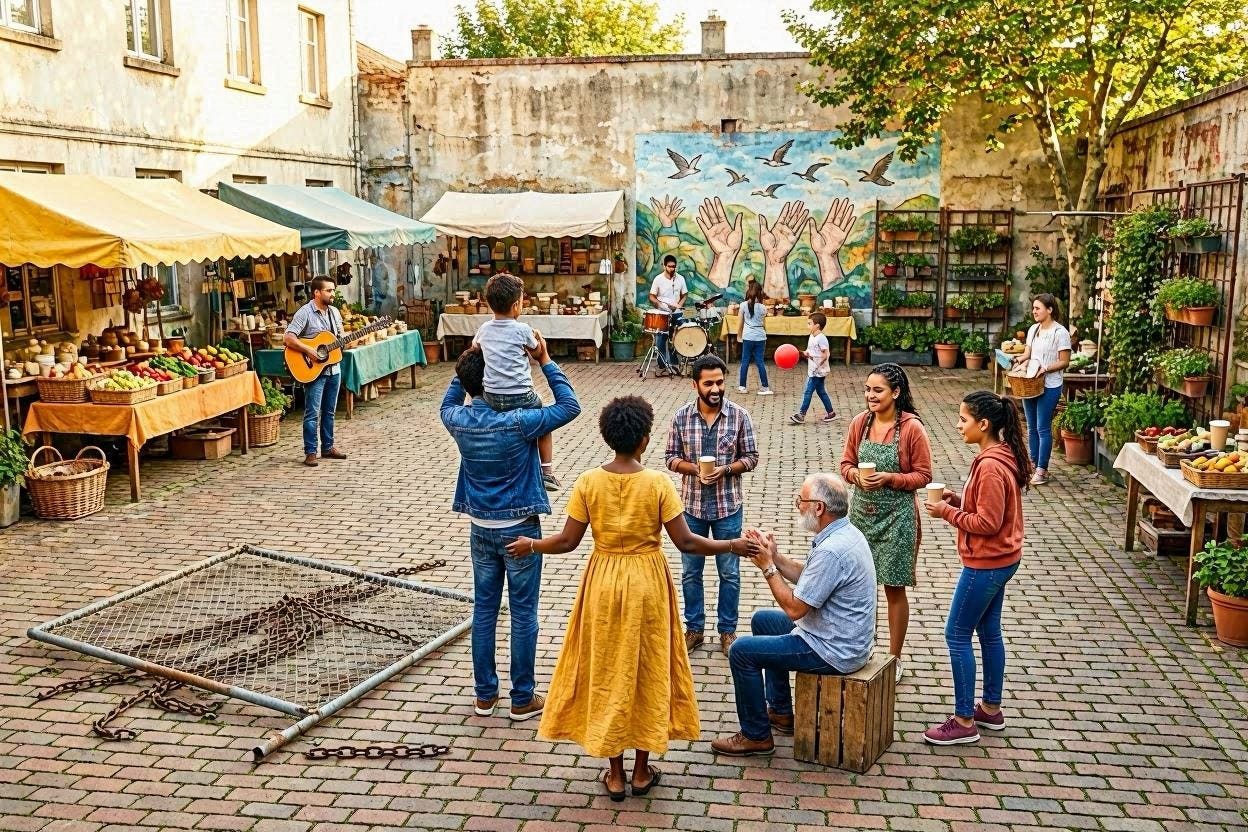
We have many dreams. Some are concrete and easily defined, while others are intangible, more like an idea, a hope, or a vision of the future. They are the images we carry of a better life, a better society, a better world for our children. They shape our aspirations and influence our decisions, determining not only our next major purchase or career move, but also how we want to live, what values we wish to uphold, and what kind of future we hope to leave behind.
Yet these visions are often fragile. The pressures of daily life can easily obscure them. Bills must be paid, responsibilities fulfilled, problems solved. The demands of the present moment can become so overwhelming that the future disappears from view. We become absorbed in reacting to circumstances rather than consciously moving towards the reality we once imagined.
Nevertheless, our visions remain important because they provide direction. A person without a vision is easily carried along by whatever happens next. A community without a vision becomes vulnerable to fear, cynicism, and division. Vision gives meaning to sacrifice and purpose to effort. It reminds us that what exists today is not necessarily what must exist tomorrow.
One of the greatest obstacles to these visions, however, is often ourselves. We can become trapped in patterns of thought that keep us focused on limitations rather than possibilities. We revisit old disappointments, replay past failures, and rehearse the reasons why things have not worked out as we hoped. There is value in learning from experience, but there is a point at which reflection becomes stagnation. If our conversations are dominated by explanations of why we have not succeeded, we risk becoming historians of our disappointments rather than architects of our future.
There is a profound difference between admiring a vision and embodying it. Many people can describe the world they would like to see. Fewer are willing to become living examples of that world. We may speak passionately about kindness while harbouring resentment, advocate for justice while excusing unfairness in our own behaviour, or long for a more compassionate society while neglecting opportunities to show compassion in our daily lives.
The future is not built solely through grand plans or dramatic transformations. More often, it emerges through countless small decisions made consistently over time. Every vision begins with an act of embodiment. If we desire a more truthful world, we must become more truthful. If we desire a more peaceful world, we must cultivate peace in our own relationships. If we desire a society built upon dignity and respect, we must treat others with dignity and respect long before society as a whole reflects those values.
The reality we long for cannot remain merely an abstract idea. It must become something we practise. It must take shape in our habits, our words, and our actions. Otherwise, it remains a dream that exists only in conversation.
This does not mean we must already be perfect or that we must achieve our vision overnight. Every worthwhile goal begins with imperfect steps. What matters is movement. A single step towards a vision is more powerful than endless discussion about why the journey is difficult. The person who stumbles forward will always travel further than the person who remains stationary while explaining the obstacles.
The challenge, therefore, is not simply to imagine a better future, but to begin living as though that future is already struggling to be born through us. The question is not only what kind of world we want to inhabit, but whether we are willing to become the kind of people capable of creating it.
For every vision that inspires us, there comes a moment when we must decide whether it will remain a distant hope or become a lived reality. The future is shaped not only by what we believe is possible, but by what we are willing to embody today.
The Deception
There is no denying that while many of our personal visions may be modest, there are also people and institutions pursuing much larger projects that often appear to enrich a small number of individuals far more than society as a whole. This has become increasingly obvious in recent decades. I remember, in the 1990s, believing that we could work together to leave the world in a better condition than we found it. The idea seemed neither radical nor naïve. It was simply assumed that progress meant improving the quality of life for future generations.
Today, however, such aspirations are often met with cynicism. The social dimension of human life is underplayed, while economic considerations dominate almost every discussion about the future. The task set before us by many politicians is no longer presented as building a better society, but as maintaining our place within an economic machine geared primarily towards growth, productivity, and profit maximisation. Citizens are increasingly treated not as participants in a shared civic project, but as units of labour whose purpose is to keep the system functioning.
This becomes apparent whenever discussions arise about work, retirement, and public policy. We are repeatedly told that our expectations are unrealistic, that we must work longer hours, retire later, and accept that previous generations enjoyed benefits that can no longer be sustained. The retirement age is pushed back, working lives are extended, and the assumption is that these sacrifices are both necessary and inevitable.
Yet a simple question arises: why?
Why, after generations of extraordinary technological innovation, are we being asked to work longer rather than less? We were told that technology would make us more efficient, reduce drudgery, and free human beings to pursue higher goals. Machines would perform tasks that once required enormous amounts of human labour. Productivity would increase. The burden of work would be reduced.
Instead, many people feel as though they are running faster merely to remain in the same place.
The answer often given is economic necessity. But there is another possibility worth considering. Perhaps the primary goal of our economic system is not the improvement of human life but the maximisation of profit. If profit remains the highest priority, then technological advances do not necessarily translate into greater leisure, stronger communities, or more meaningful lives. They simply become tools for generating additional returns.
Under such a system, there is never enough productivity. There is never enough growth. There is never enough labour. No matter how much efficiency increases, the benefits flow disproportionately upwards, while ordinary people are expected to accept incremental rewards as sufficient compensation. We are encouraged to work harder, take fewer holidays, remain economically productive for more years, and postpone the things that give life meaning. Time with family, participation in community life, artistic pursuits, civic engagement, and simple human companionship become secondary concerns.
The tragedy is not merely economic. It is cultural and psychological. Human beings need more than material consumption. We need purpose, belonging, and the feeling that our efforts contribute to something worthwhile. When society appears to offer only the promise of working more in exchange for diminishing rewards, younger generations naturally begin asking a fundamental question: what exactly are we working for?
That question is often dismissed as entitlement or pessimism, but it may actually be a sign of healthy reflection. A civilisation that cannot explain why its members should make sacrifices beyond the accumulation of wealth is a civilisation that risks losing its moral centre.
Yet despite growing dissatisfaction, younger generations are frequently asked to contribute more while expecting less. They face higher barriers to home ownership, greater economic insecurity, and uncertain prospects for retirement. At the same time, they are encouraged to serve institutions whose priorities they increasingly distrust. They are told to dedicate themselves to economic goals they did not choose and, if necessary, to military objectives determined by governments whose vision of the future may not be their own.
The danger is not simply economic decline. It is the emergence of a society in which people cease to believe that collective progress is possible. Once that belief disappears, cynicism takes its place. Citizens become consumers, communities become markets, and politics becomes little more than the management of competing interests.
This is the beginning of a downward spiral that many people instinctively recognise. Not because they expect an overnight collapse into dystopia, but because they sense that something essential is being lost. A society cannot thrive indefinitely if it asks more and more from its people while offering them less meaning, less security, less community, and less hope in return.
The challenge before us is therefore larger than debates about pensions, wages, or productivity. It is the question of what civilisation is for. Is the purpose of society merely to maximise economic output, or is it to create the conditions in which human beings can flourish? If we lose sight of that question, then no amount of growth will be enough. But if we recover it, technological progress, economic activity, and political life can once again become tools for serving humanity rather than ends in themselves.
The future depends upon which vision we choose to embody.
Break Free
This also means that if we are to embody a future from which our children and their children can genuinely benefit, we must free ourselves from the assumptions and habits that bind us to the present. Of course, we must work for the future. Every generation inherits a world it did not create and bears some responsibility for the world it passes on. We must contribute, build, create, and cooperate. But if our labour is to serve human flourishing rather than merely economic expansion, then we need limits on the relentless pursuit of profit and a renewed commitment to innovation that improves the quality of people’s lives rather than simply increasing financial returns.
We need a society built upon solidarity. A society in which nobody is left behind, nobody is overlooked, and everybody can see that their needs, aspirations, and dignity matter. The measure of a successful society should not simply be how much wealth it generates, but how well it enables its people to live meaningful, secure, and fulfilling lives. Economic activity is a tool; it should never become the purpose of civilisation itself.
At present, however, many people feel that they are being guided by individuals and institutions that possess more wealth and influence than previous generations could have imagined, yet still insist that there is never enough. The message often conveyed is that the current arrangement of society is inevitable, that there is no alternative to the priorities that dominate public life, and that we must simply adapt ourselves to them. We are told that competition is natural, that insecurity is unavoidable, and that human beings must continually prove their worth through productivity.
At the same time, frustration and anxiety are frequently redirected towards those who are themselves struggling. The unemployed, immigrants, welfare recipients, public-sector workers, pensioners, or younger generations are each, at different moments, presented as obstacles to prosperity. The implication is that if only these groups demanded less, everyone else could finally enjoy the life they seek.
Yet this narrative serves to divide people who share many of the same concerns. It encourages ordinary people to compete against one another while paying less attention to the broader structures that shape economic and political life. It turns neighbours into rivals and directs anger sideways rather than upwards. In doing so, it obscures difficult but necessary questions about power, wealth, and who benefits most from the way society is organised.
There is also a growing sense that many of the institutions surrounding us have become deeply invested in ensuring that few aspects of life exist outside commercial relationships. Increasingly, every activity, interest, relationship, and form of communication becomes an opportunity for monetisation. Social media platforms seek to capture attention. Digital services seek subscriptions. Communities that once organised themselves informally are increasingly replaced by commercial alternatives. The space in which people can simply gather, create, cooperate, and belong without economic mediation appears to shrink.
The cultural consequences of this are profound. Much of what we consume is designed not to deepen our understanding of one another but to maximise engagement. Fear, outrage, conflict, and anxiety hold attention more effectively than peace, cooperation, and contentment. Stories become dominated by struggle, conflict, crime, catastrophe, or fantasies of heroic individuals defeating enemies. Again and again, we are presented with the same underlying message: the world is hostile, there is always an enemy, and survival depends upon defeating someone else.
Yet our deepest satisfactions rarely come from conflict. The moments that remain with us are usually very different.
They come from harmony rather than domination. From working together towards a shared purpose. From building something that will outlast us. From planting trees whose shade we may never sit beneath. From teaching, mentoring, creating, and caring.
They come from activities that appear almost useless when measured by economic standards but are essential to being human. Singing together. Dancing together. Sharing meals. Telling stories. Making art. Walking with friends. Laughing until tears come. Sitting with those we love without feeling the need to justify the time spent.
They come from belonging to communities in which people are known rather than merely counted. Communities where the elderly are not isolated, where the sick are cared for, and where loneliness is recognised as a collective concern rather than a private failure. Communities in which people understand that every individual has value simply by virtue of being human.
These experiences remind us of something that modern society often struggles to acknowledge: that human beings are not merely producers and consumers. We are social, creative, and relational beings. We seek meaning as much as comfort, belonging as much as wealth, and purpose as much as efficiency.
If we wish to build a future worthy of future generations, we must recover that understanding. We must resist the temptation to believe that life is solely an economic competition and remember that the greatest achievements of civilisation have always been collective achievements. They have emerged when people have chosen cooperation over division, solidarity over isolation, and hope over cynicism.
The future we long for will not emerge automatically from technological progress or economic growth. It will emerge when enough people begin to embody, in their own lives and communities, the values they wish to see reflected in the world. The task before us is not merely to imagine a better society, but to begin living as though such a society is possible.
Just Do It!
If we look back through history, we find that countless people have held visions remarkably similar to this one. They imagined societies built on cooperation rather than competition, communities where people cared for one another, and neighbourhoods in which nobody was forgotten. Some of these visions achieved remarkable things for a time, while others faded away. Yet one lesson appears again and again: ideas alone are not enough. The greatest obstacle to a better future is often not opposition but inaction. People talk about what should be done far more often than they actually do it.
Of course, every one of us faces limitations. We have jobs, responsibilities, financial pressures, family commitments, and countless demands upon our time. We cannot solve every problem or transform society overnight. But we do not need to. The mistake many people make is believing that meaningful change must begin with governments, corporations, or large organisations. In reality, many of the most important changes begin when ordinary people decide to act together.
When people come together with goodwill and a shared purpose, remarkable things happen.
Someone places a barbecue outside a block of flats and invites a few neighbours. One person brings sausages, another brings salad, someone else brings drinks, and before long, what began as a simple idea becomes a gathering. People who previously passed each other in silence begin learning each other’s names. Conversations start. Friendships form. Children play together. What looked like a collection of strangers starts becoming a community.
Do it once, and it is a pleasant afternoon.
Do it regularly, and it becomes part of the culture of the neighbourhood.
The same is true of celebrations. Someone has a birthday, an anniversary, or another occasion worth marking and invites the neighbours. People who barely knew one another find themselves singing together, sharing stories, exchanging memories, and organising surprises. The event itself may be small, but the relationships it creates are not. Every shared experience adds another thread to the fabric that binds people together.
These may seem like insignificant acts in a world facing enormous challenges, but they are precisely the sort of first steps from which larger changes emerge. Community is not created through slogans or policy papers. It is created through repeated acts of participation. It grows whenever people find reasons to gather, cooperate, and care about one another’s well-being.
As these connections deepen, something interesting begins to happen. People start helping one another without being asked. They share tools, skills, advice, and support. They check on elderly neighbours. They notice when someone is struggling. They celebrate each other’s successes and provide comfort during difficult times. Trust develops where previously there was only distance.
In time, the community becomes more resilient and more autonomous. Problems that once felt overwhelming become easier to address because people no longer face them alone. A neglected garden becomes a community project. A lonely resident gains companionship. A struggling family receives practical support. Small acts accumulate into something much larger than any individual could have achieved.
What is especially encouraging is that these efforts tend to grow organically. Those who were not initially involved often become curious. They see people enjoying themselves, helping one another, and building something worthwhile. Eventually, they join in. The circle widens. What began with a handful of participants becomes something that belongs to everyone.
Nothing is perfect at the beginning. Gatherings can be awkward. Plans sometimes fail. Attendance may be inconsistent. Disagreements will arise. But perfection is not the goal. The goal is participation. Communities, like people, learn through practice. Every successful tradition was once an experiment. Every thriving neighbourhood began with a few people deciding to make the effort.
We often imagine that changing the world requires extraordinary leaders or revolutionary events. More often, it requires ordinary people doing ordinary things consistently. It requires people to decide that they will no longer wait for permission to care about one another. It requires the courage to take the first step, however small it may seem.
The future we want will not appear fully formed. It will emerge gradually through thousands of small acts of cooperation, generosity, and participation. Every meal shared, every neighbour helped, every conversation started, and every community event organised becomes part of that process.
So if the vision matters, do not simply talk about it.
Do it.
Invite someone. Organise something. Plant something. Fix something. Celebrate something. Bring people together.
The world changes when people stop waiting for the perfect moment and begin creating the future where they are, with what they have, and with whoever is willing to join them.